
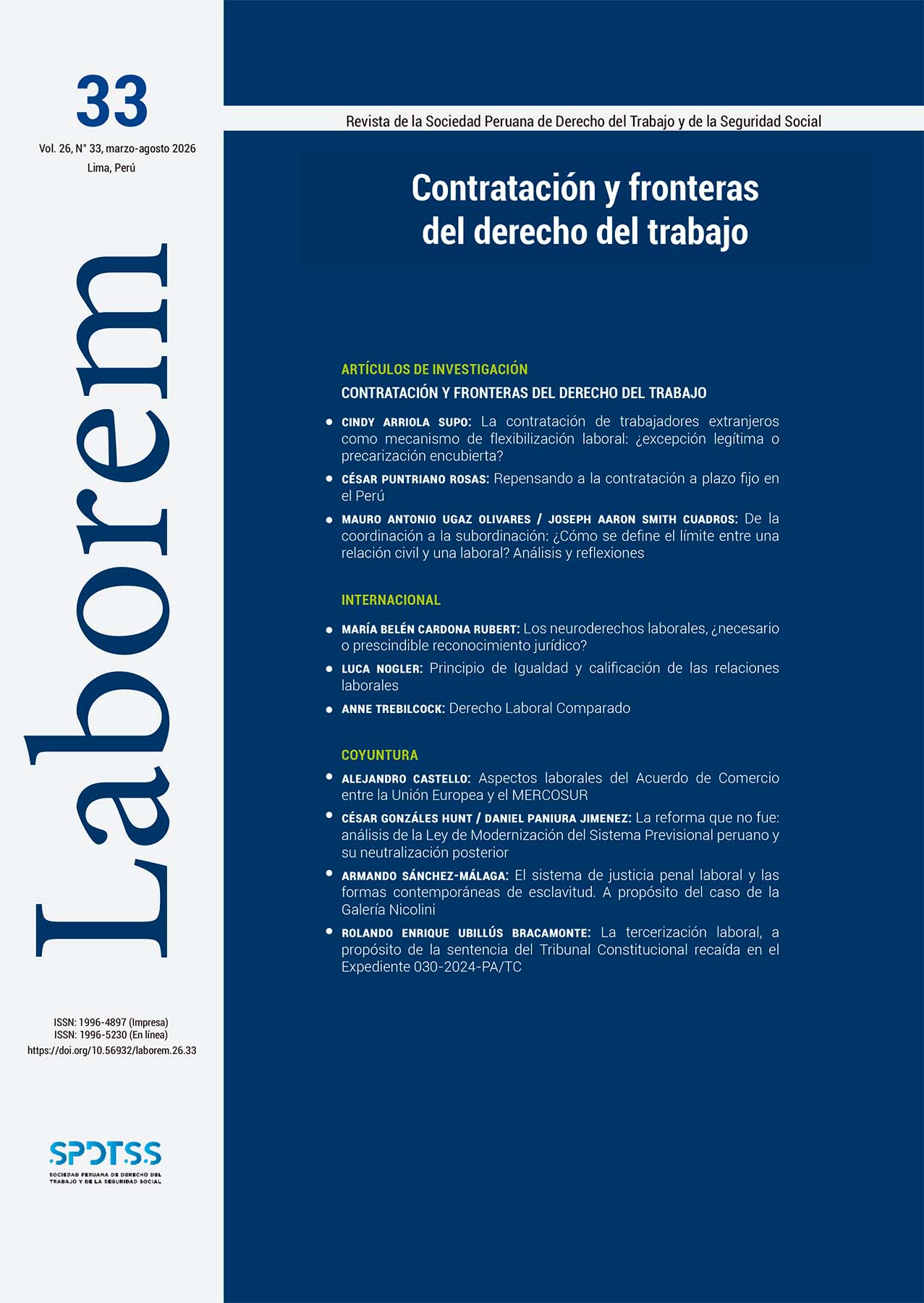
Derecho Laboral Comparado
DOI:
https://doi.org/10.56932/laborem.26.33.6Palabras clave:
Derecho Laboral Comparado, relación laboral, fuentes del derecho laboralResumen
La reconocida profesora Anne Trebilcock ofrece una revisión sistemática del Derecho Laboral Comparado como un campo dinámico que ha experimentado un renovado impulso ante la globalización, la transformación tecnológica y la fragmentación de los mercados de trabajo. La autora sostiene que la comparación ya no puede limitarse al análisis horizontal entre legislaciones nacionales, sino que debe incorporar una dimensión vertical que integre normas internacionales, acuerdos comerciales, iniciativas privadas y mecanismos de gobernanza transnacional. En este contexto, el Derecho Laboral Comparado se presenta como una herramienta para examinar cuestiones estructurales —como la identificación de la relación laboral, la regulación del trabajo en la economía informal y de plataformas, la eficacia de los derechos colectivos o la articulación entre desarrollo y protección social—, destacando tanto su potencial explicativo como sus límites metodológicos.
El texto profundiza en los usos, riesgos y métodos del ejercicio comparativo, subrayando la importancia de contextualizar las normas en su entorno político, económico y social, en línea con la tradición funcionalista. Se analizan fenómenos como la transposición normativa, los trasplantes legales y la “traducción” de instituciones jurídicas, advirtiendo sobre los peligros de una transferencia acrítica de modelos. Asimismo, se examinan las principales fuentes —desde la legislación y la jurisprudencia hasta bases de datos internacionales y redes académicas— y se destaca un giro hacia enfoques más empíricos e interdisciplinarios. En definitiva, la autora concluye que, pese a su complejidad, el Derecho Laboral Comparado sigue siendo una herramienta indispensable para comprender la evolución del trabajo y diseñar reformas jurídicas informadas y contextualizadas.
Descargas
Citas
Publicado como “Introducción” del libro Comparative Labour Law de Anne Trebilcock (ed.). Edward Elgar, 2018, p. xiii-xxxix. El libro se enfoca en la literatura en inglés sobre la materia.
Traducción y edición a cargo de los directores de Laborem.
Ex asesora legal y directora del departamento de asuntos jurídicos de la Organización Internacional del Trabajo.
MATTHEW FINKIN & GUY MUNDLAK, eds., RESEARCH HANDBOOK ON COMPARATIVE LABOUR LAW (Cheltenham, UK and Northampton, MA, USA: Edward Elgar Publishing, 2015) 1 [Finkin & Mundlak]; Neal (2015). Óp. Cit. 174.
BOB HEPPLE, LABOUR LAWS, AND GLOBAL TRADE (London: Hart, 2005), 270.
Véase, por ejemplo, GUY DAVIDOV & BRIAN LANGILLE, eds, THE IDEA OF LABOUR LAW (Oxford: Oxford University Press, 2011) [Davidov & Langille]; KATHERINE V.W. STONE & HARRY ARTHURS, eds, RETHINKING WORKPLACE REGULATION (London: Russell Sage, 2013) [Stone & Arthurs]; Frank Hendrickx, Foundations and Function of Contemporary Labour Law, 3(2) EUROPEAN LABOUR LAW JOURNAL (2012) 108–29; Rose-Marie Belle Antoine, Rethinking Labor Law in the New Commonwealth Caribbean Economy: A Framework for Change, 32(2) COMPARATIVE LABOR LAW & POLICY JOURNAL (2011) 343–71 [Antoine 2011]; CYNTHIA ESTLUND, REGOVERNING THE WORKPLACE: FROM SELF-REGULATION TO CO-REGULATION (New Haven, CT: Yale University Press, 2010); ROSEMARY OWENS & JOELLEN RILEY, THE LAW OF WORK (Oxford: Oxford University Press, 2007).
Shelley Marshall, Revitalizing Labour Market Regulations for the Economic South: New Forms and Tools, in LABOUR REGULATION AND DEVELOPMENT: SOCIO-LEGAL PERSPECTIVES (Shelley Marshall & Colin Fenwick, eds, Cheltenham, UK and Northampton, MA, USA: Edward Elgar Publishing, 2016) 288 [Marshall & Fenwick].
Véase, por ejemplo, Mark Barenberg, International Labour Indicators: Conceptual and Normative Snares, in RESEARCH HANDBOOK ON TRANSNATIONAL LABOUR LAW (Adelle Blackett & Anne Trebilcock, eds, Cheltenham, UK and Northampton, MA, USA: Edward Elgar Publishing, 2015) 76–92 [Blackett & Trebilcock].
Véase Marshall in Fenwick & Marshall, op. cit.; ADRIENNE E. EATON, SUSAN J. SCHURMAN & MARTHA A. CHEN, eds, INFORMAL WORKERS AND COLLECTIVE ACTION (Ithaca, NY: ILR Press, 2017); JUDY FUDGE, SHAE McCRYSTAL & KAMALA SANKARAN, eds, CHALLENGING THE LEGAL BOUNDARIES OF WORK REGULATION (London: Hart, 2012).
Véase, por ejemplo, J. PRASSL, THE CONCEPT OF THE EMPLOYER (Oxford: Oxford University Press 2015); BERND WAAS & GUUS HEERMA VAN VOSS, RESTATEMENT OF LABOUR LAW IN EUROPE, Vol. 1: THE CONCEPT OF THE EMPLOYEE (London: Hart, 2017); Guy Davidov, Mark Freedland & Nicola Kountouris, The Subjects of Labour Law: ‘Employees’ and Other Workers, in Finkin & Mundlak, op. cit.; HUGH COLLINS, PAUL DAVIES & R.W. RIDEOUT, eds, LEGAL REGULATION OF THE EMPLOYMENT RELATION (Alphen aan den Rijn: Kluwer Law International, 2002).
Véase, por ejemplo, DAVID WEIL, THE FISSURED WORKPLACE (Cambridge, MA: Harvard University Press, 2014); LAURA CARLSON, COMPARATIVE DISCRIMINATION LAW: HISTORICAL AND THEORETICAL FRAMEWORKS (London: Brill, 2017); BOB HEPPLE, EQUALITY: A NEW LEGAL FRAMEWORK, 2nd ed. (London: Hart, 2014).
Véase, por ejemplo, Donini et al., Chapter 19 in this volume and INTERNATIONAL LABOUR ORGANIZATION, DECENT WORK IN GLOBAL SUPPLY CHAINS, International Labour Conference, 105th Session, 2016, Report IV, and Resolution concerning decent work in global supply chains, adopted by the Conference on 10 June 2016.
Véase, por ejemplo, MICHAEL J. TREBILCOCK & RONALD J. DANIELS, RULE OF LAW REFORM AND DEVELOPMENT: CHARTING THE FRAGILE PATH OF PROGRESS (Cheltenham, UK and Northampton, MA, USA: Edward Elgar Publishing, 2008).
ROGER BLANPAIN, ed., COMPARATIVE LABOUR LAW AND INDUSTRIAL RELATIONS IN INDUSTRIALIZED MARKET ECONOMIES, 10th ed. (Kluwer Law International, 2014) [Blanpain 2014].
E.g. MINAWA EBISUI, SEAN COONEY & COLIN FENWICK, eds, RESOLVING INDIVIDUAL LABOUR DISPUTES: A COMPARATIVE OVERVIEW (ILO, 2016); GREGOR THÜSING & GERRIT FORST, WHISTLEBLOWING – A COMPARATIVE STUDY (Springer, 2016).
Véase, por ejemplo, DEIDRE MCCANN, SANGHEON LEE, PATRICK BELSER, COLIN FENWICK, JOHN HOWE & MALTE LUEBKER, eds, CREATIVE LABOUR REGULATION: INDETERMINACY AND PROTECTION IN AN UNCERTAIN WORLD (ILO, 2014); Silvana Sciarra, The ‘Autonomy’ of Private Governance Building on Italian Labour Law Scholarship in a Transnational Perspective, in NORMATIVE PATTERNS AND LEGAL DEVELOPMENTS IN THE SOCIAL DIMENSION OF THE EU (Ann Numhauser-Henning & Mia Rönnmar, eds, Hart, 2013) 65–75; CYNTHIA ESTLUND, REGOVERNING THE WORKPLACE: FROM SELF-REGULATION TO CO-REGULATION (Yale University Press, 2010).
Véase Fenwick y Kalula (2005). Óp. Cit. 194
Finkin & Mundlak, op. cit., 16; Kerry Rittich & Guy Mundlak, The Challenge to Comparative Labor Law in a Globalized Era, in Finkin & Mundlak, 80–111; Alan Hyde & Emanuele Menegatti, Legal Protection for Employee Mobility, in Finkin & Mundlak, 195–219.
Marlese von Broembsen & Shane Godfrey, Labour Law, and Development Viewed from Below: What do Case Studies of the Clothing Sectors in South Africa and Lesotho tell us? in Marshall & Fenwick, op. cit., 127–61, 128 [von Broembsen & Godfrey].
Shelley Marshall & Colin Fenwick, Labour Law, and Development: Characteristics and Challenges, in Fenwick & Marshall. Óp. Cit., 1–32.
Este ha sido un leitmotiv desde el lanzamiento de la Agenda de Trabajo Decente de la OIT en 1999 hasta la articulación de los Objetivos de Desarrollo Social 2030. Algunos académicos lo han utilizado como punto de partida; véase, por ejemplo, Stefan van Eck, Revisiting Agency Work in Namibia and South Africa: Any Lessons from the Decent Work Agenda and the Flexigurity Approach? 30:1 INTERNATIONAL JOURNAL OF COMPARATIVE LABOUR LAW AND INDUSTRIAL RELATIONS (2014) 49–66.
Antoine 2011. Óp. Cit., 370.
Kamala Sankaran, Labour Law in South Asia: A Right to Development Perspective, in Marshall & Fenwick. Óp. Cit., 207–34, 230.
Véase, por ejemplo, Hugh Collins, Theories of Rights as Justifications for Labour Law, in THE IDEA OF LABOUR LAW (Brian Langille & Guy Davidov, eds, Oxford University Press, 2011) 137–55; Miriam Kullmann, The Principle of effect utile and its Impact on National Methods for Enforcing Rights of Posted Workers, 29(3) INTERNATIONAL JOURNAL OF COMPARATIVE LABOUR LAW & INDUSTRIAL RELATIONS (2013) 283–303.
Por ejemplo, las teorías del desarrollo de Amartya Sen y Martha Nussbaum han atraído considerable atención entre quienes escriben sobre derecho laboral. Véase von Broembsen y Godfrey, en Marshall y Fenwick, óp. cit.; Kevin Kolben, Labour Regulation, Capabilities and Democracy, en Marshall y Fenwick, óp. cit., 60-81. Kolben también examina el trabajo de otros autores (Langille, Fudge) en relación con el enfoque de las capacidades. Para un análisis previo, véase Anne Trebilcock, Using Development Approaches to Address the Informal Economy in Labour Law, en THE FRONTIERS AND BOUNDARIES OF LABOUR LAW (Brian Langille y Guy Davidov, eds., Londres: Hart, 2006), 63-96.
MARK FREEDLAND & NICOLA KOUNTOURIS, THE LEGAL CHARACTERIZATION OF PERSONAL WORK RELATIONS (Oxford: Oxford University Press, 2012); MARC RIGAUX, JAN BUELENS & AMANDA LATINNE, eds, FROM LABOUR LAW TO SOCIAL COMPETITION LAW? (Cambridge: Intersentia, 2014); JUDY FUDGE, SHAE MCCRYSTAL & KAMALA SANKARAN, eds, CHALLENGING THE LEGAL BOUNDARIES OF WORK REGULATION (London: Hart, 2012); Antoine 2011. Óp. Cit.
Anthony Forsyth, John Howe, Peter Gahan & Ingrid Landau, Establishing the Right to Bargain Collectively in Australia and the United Kingdom: Are Majority Support Determinations under the Australia Fair Work Act a More Effective Form of Recognition? 46(3) INDUSTRIAL LAW JOURNAL (2017) 335–65; RUTH DUKES, THE LABOUR CONSTITUTION: THE ENDURING IDEA OF LABOUR LAW (Oxford: Oxford University Press, 2014).
E.g. Kerstin Ahlberg, Complicated Relations between EU and Nordic Labour Law Systems, summarizing JENS KRISTENSEN, ed., EUROPE AND THE NORDIC COLLECTIVE AGREEMENT MODEL (2015), NORDIC LABOUR JOURNAL (17 June 2015), http://www.nordiclabourjournal.org/nyheter/news-2015/article.2015-06-17.0778762183 (accessed 29 June 2018); Takashi Araki, A Comparative Analysis of Security, Flexibility, and Decentralized Industrial Relations in Japan, 28:3 COMPARATIVE LABOUR LAW & POLICY JOURNAL (2007) 443–54 [Araki].
Colin Fenwick, The ILO and National Labour Law Reform: Six Case Studies, in Marshall & Fenwick, op. cit., 235–87 [Fenwick, Six Studies]; Shelley Marshall, How Does Institutional Change Occur? Two Strategies for Reforming the Scope of Labour Law, 43(3) INDUSTRIAL LAW JOURNAL (2014) 286.
E.g. Stewart J. Schwab, Law-and-Economics Approaches to Labor and Employment Law, 33(1) INTERNATIONAL JOURNAL OF COMPARATIVE LABOUR LAW AND INDUSTRIAL RELATIONS (2017) 115–44.
Neal (2015). Óp. Cit. 161.
Araki. Óp. Cit, 454.
Alvaro Santos, The Trouble with Identity and Progress Origins in Defending Labour Law, in CRITICAL LEGAL PERSPECTIVES ON GLOBAL GOVERNANCE: LIBER AMICORUM DAVID M. TRUBEK (Gráinne de Búrca, Claire Kilpatrick & Joanne Scott, eds, London: Hart, 2014) 207–46.
Thomas C. Kohler, Comparative Law in a Time of Globalization: Some Reflections, 52(1) DEQUESNE LAW REVIEW (2014) 101–14.
Otto Kahn-Freund (1974), Sobre los usos y abusos del derecho comparado, 37(1) MODERN LAW REVIEW 1–27. La mayor parte del artículo se centra en el derecho de familia y el derecho administrativo, y la sección final se dedica al derecho de las relaciones laborales. Esto, junto con la antigüedad de muchos de sus ejemplos, abogó por incluir en su lugar un artículo comentado por Kahn-Freund. El artículo de Kahn-Freund aparece en JAN SMITS, ELGAR ENCYCLOPEDIA OF COMPARATIVE LAW, 2.ª ed. (Cheltenham, Reino Unido y Northampton, MA, EE. UU.: Edward Elgar Publishing, 2012) [Smits].
Kahn-Freund. Óp. Cit., 27.
Véase, por ejemplo, Ruth Dukes, Constitutionalizing Employment Relations: Sinzheimer, Kahn-Freund and the Role of Labour Law, 35(3) JOURNAL OF LAW & SOCIETY (2008) 341–63.
Rittich & Mundlak. Óp. Cit, 80.
Tzehainesh Teklè, Labour Law and Worker Protection in the South: An Evolving Tension between Models and Reality, in Teklè. Óp. Cit., 3.
Clyde Summers, Comparisons in Labor Law: Sweden and the United States, in Startryk ur Svensk Juristtidning 589, 615 (1983)..
Arthurs (2007). Óp. Cit. 608,
Alan Bogg & Keith Ewing, Freedom of Association, in Finkin & Mundlak, Óp. Cit., 298
Valerio de Stefano, The Rise of the ‘Just-in Time Workforce’: On Demand Work, Crowdwork and Labour Protection in the Gig-Economy, 37(3) COMPARATIVE LABOR LAW & POLICY JOURNAL (2016) 471–503, en un número especial que editó como invitado.
Mimi Zou, The Regulatory Challenges of Uberization in China: Classifying Ride-Hailing Drivers, 33(2) JOURNAL OF COMPARATIVE LABOUR LAW AND INDUSTRIAL RELATIONS (2017) 269–94; Antonio Rodrigues de Freitas Junior & Victor Raduan da Silva, The Uberization of Work and the Legal Regulation: The Challenge of Labour Protection in Semi-Peripheral Economies, Paper Presented at 3rd Labour Law Research Network, Toronto, June 2017 (véase el sitio web del LLRN).
Por ejemplo, Michael Rawling & John Howe, The Regulation of Supply Chains: An Australian Contribution to Cross-National Legal Learning, in Stone & Arthurs, op. cit., 233–52.
Por ejemplo, Fenwick in Marshall & Fenwick, Óp. Cit.; María Luz Vega Ruíz, New Trends in Latin American Labour Reforms: The Law, its Reform and its Impact in Practical Terms, in IN DEFENCE OF LABOUR MARKET INSTITUTIONS: CULTIVATING JUSTICE IN THE DEVELOPING WORLD (Janine Berg & David Kucera, eds, London: Palgrave Macmillan/ILO, 2008) 233–63 [Vega Ruíz]; Franz Christian Ebert, The International Financial Institutions’ Approach to Labour Law: The Case of the International Monetary Fund, in Blackett & Trebilcock, Óp. Cit., 124–37.
Véase por ejemplo, Martin Warren, Employment: When in Rome, THE LAWYER ONLINE (2007), www.thelawyer.com/issue/21-may-2007, 1–3, which examines the EU Transfer of Undertakings (Protection of Employment) Regulations from the perspective of firms outsourcing work to India, and The Export-Import Bank of India, Comparison of Labour Laws: Selected Countries, Occasional Paper No. 160 (2013), que presenta la legislación de 21 países como fuente de ideas para mejorar la competitividad de la Inda..
Por ejemplo, Jacques Rojot, Future Directions for Labor Law Scholarship and International Collaboration, 28(3) COMPARATIVE LABOR
LAW & POLICY REVIEW (2007) 583–89.
Véase, por ejemplo, JANICE BELLACE & BERYL TER HAAR, eds, RESEARCH HANDBOOK ON BUSINESS AND LABOUR RIGHTS (Cheltenham, UK and Northampton, MA, USA: Edward Elgar Publishing, forthcoming; Bellace & ter Haar].
Rittich & Mundlak, Óp. Cit., 111.
Statement at Conference, Partnership Project – Institutional Experimentation for Better Work, Magog, Canada, 27 October 2017. Por un ejemplo clásico, véase Darcy du Toit, Comparing the Interpretation of ‘Equality’ by the European Court of Justice and the South African Constitutional Court, 36(3) COMPARATIVE LABOR LAW & POLICY JOURNAL 423–47 [du Toit].
Por ejemplo, Renée-Claude Drouin, Freedom of Association in International Framework Agreements, in Blackett & Trebilcock, Óp. Cit.; Alvin L. Goldman, Enforcement of International Framework Agreements under U.S. Law, 33(4) COMPARATIVE LABOR LAW & POLICY JOURNAL (2012) 605–34; Rüdiger Krause, International Framework Agreements as Instruments for the Legal Enforcement of Freedom of Association – the German Case, 33(4) COMPARATIVE LABOR LAW & POLICY JOURNAL (2012) 749–73.
E.g. Silvia Bonfanti, Cynthia Estlund & Nuno Garoupa, Comparative Labor and Employment Law in Developed Market Economies: Fostering Market Efficiencies or Repairing Market Failures? in Finkin & Mundlak, Óp. Cit., 62–79 [Bonfati et al.]; Niklas Bruun & Bob Hepple, Economic Policy and Labour Law, in Hepple & Veneziani, Óp. Cit., 31–58; KENNETH DAU-SCHMIDT, S. HARRIS AND O. LOBEL, eds, LABOR AND EMPLOYMENT LAW AND ECONOMICS (Cheltenham, UK and Northampton, MA, USA: Edward Elgar Publishing, 2009).
Véase, por ejemplo, Berg & Kucera, Óp. Cit.
Véase, por ejemplo, Joanne Conaghan, Labour Law and Feminist Method, 33(1) INTERNATIONAL JOURNAL OF COMPARATIVE LABOUR LAW & INDUSTRIAL RELATIONS (2017) 199–238.
Steven Willborn, Onward and Upward: The Next Twenty-Five Years of Comparative Labour Law Scholarship, (2003–2004) 25 COMPARATIVE LABOR LAW & POLICY JOURNAL 183–96.
Véase, por ejemplo, Adelle Blackett, Regulatory Innovation on Decent Work for Domestic Workers in the Light of International Labour Organization Convention No. 189, 34(2) INTERNATIONAL COMPARATIVE LABOUR LAW AND INDUSTRIAL RELATIONS JOURNAL (2018) 141–48; FRED C.A. VAN HASSTEREN, DECENT FLEXIBILITY: THE IMPACT OF ILO CONVENTION 181
Publicado
Cómo citar
Número
Sección
Licencia
Derechos de autor 2026 Laborem

Esta obra está bajo una licencia internacional Creative Commons Atribución 4.0.






 Los artículos publicados se encuentran disponibles en acceso abierto bajo la licencia